
Bottom Shelf: Why Have There Been No Great Women Artists? by Linda Nochlin
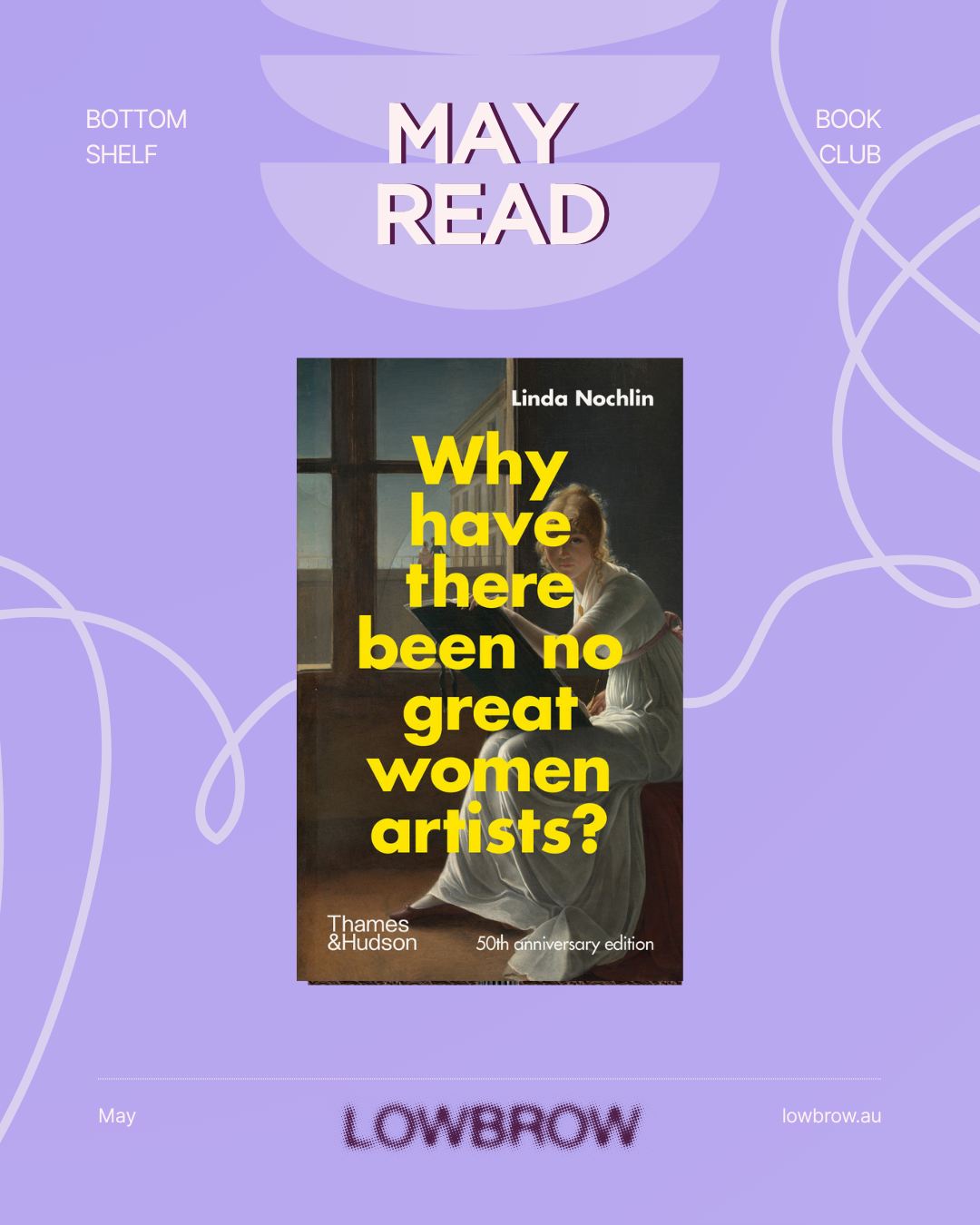
Nochlin’s ever-debated 1971 essay is a cornerstone of feminist art history and critical theories. First published in ArtNews, it’s been widely shared and discussed in the 55 years since it was first published.
Today’s Bottom Shelf read and review are short, mainly because the central question is titular, but also because my list of further reading on the subject is essentially homework.
Rereading Why Have There Been No Great Women Artists? is an annual experience for me, often precipitated by a friend saying they haven’t yet pulled it up. A foundational text, if not the foundational text of looking at feminism(s) in art history, Why Have There Been No Great Women Artists is an essay that is never far from my mind. From first reading it at 19 in ARTH101 in undergrad, I’ve variously argued for, against, outside of, and in need of redressing, Nochlin’s most famous work. As someone who comes to art through an art historical lens, rather than a hands on practice, I am always surprised with the gap between the theory and the history taught in art schools. I’m not saying this as a blanket statement – obviously everyone is a unique individual – but it is a piece of text that is so ubiquitous when studying art history, I cannot imagine writing about, critiquing, or even considering much of much of the art and exhibitions I see without a thorough knowledge of it in my back pocket.
My love and constant references to this text are not without asterixes. No writing is perfect, and none of the thoughts I have today will remain constant. My relationship with Nochlin’s theories are in a constant state of flux, from day to day, exhibition to exhibition, book to book. I cannot say with my whole chest whether I agree with Nochlin, or that I even disagree with her. I am older and (perhaps) wiser than I was when I first read it. I can hold the two facts that women have always had the capacity for greatness, and the fact that society did not allow them to explore that capacity to the fullest extent, and know them to be true. I have and will continue to change my mind on her central thesis, but it holds true that it is only recently that women (in a full, expansive view of the word) could be elevated to greatness, and that greatness, if even bestowed, only ever comes posthumously, and with an asterix and thank you to her husband/father/brother.
Questions for Discussion:
What’s your engagement with the titular question of the text and the 1971 context Nochlin presents it in?
Have you read it before, and if yes, how have your feelings about it evolved over time?
What is your relationship to theory, whether as an artist yourself or a viewer?
To answer my own questions:
Nochlin herself is well aware of the moment she is writing in. Her first sentences make that clear to us. A moment of rupture from what has been the status quo, “natural” in her words making reference to John Stuart Mill.
“At a moment when all disciplines are becoming more self-conscious, more aware of the nature of their presuppositions as exhibited in the very languages and structures of the various fields of scholarship, such uncritical acceptance of “what is” as “natural” may be intellectually fatal. Just as Mill saw male domination as one of a long series of social injustices that had to be overcome if a truly just social order were to be created, so we may see the unstated domination of white male subjectivity as one in a series of intellectual distortions which must be corrected in order to achieve a more adequate and accurate view of historical situations.”
I would argue that we are in a similar moment of rupture, from a collective culture to a highly individualized one. In the span of 10 years we have gone from a common language, distinctive, visual culture, to a hegemony where our individuality is reflected back to us in our algorithms, rather than with the visual identity of sub-cultures that were so prevalent in the second half of the twentieth century.
In response to my second and third questions, my interrogation of the text continues to evolve, and I don’t see that changing any time soon. You can never read the same book twice – the words may be the same but you aren’t, and you certainly can’t read something for the first time again. I more fully delved into my fluctuating feelings earlier, and I can’t wait to read it again in two months and find something new. Nochlin’s work is one of many that I like returning to as my own test of how I’m feeling about the art world I am in the midst of. Taking time to reflect on my relationships with critical theory and texts allows me to more fully flesh out my thoughts on everything I am seeing, and remind myself of the contexts in which I write.
Now, in lieu of a real conclusion, I present to you my continued reading list:
Kathie Muir - Feminism and Representations of Union Identity in Australian Union Banners of the 1980s and early 1990s
Katy Hessel - The Story of Art Without Men
Breanne Fahs - Burn It Down!: Feminist Manifestos for the Revolution
Rosalind E. Krauss - The Optical Unconscious
Kimberly Drew & Jenna Wortham - Black Futures
Joan Didion- Slouching Towards Bethlehem
Lauren Elkin - Art Monsters: Unruly Bodies in Feminist Art
Nochlin’s essay is available to read here: https://www.artnews.com/art-news/retrospective/why-have-there-been-no-great-women-artists-4201/
Bottom Shelf is Lowbrow’s monthly bookclub. If you had any thoughts on Why Have There Been No Great Women Artists?, or have a suggestion for a future book, please contact Charlotte at bottomshelf.lowbrow@gmail.com
Graphics courtesy of @alicebeyerdesign