
Lowbrow goes Highbrow: NEW26 - ACCA
Nicholas Currie
I’m writing this feeling a little bit dusty after our first Lowbrow happy hour last night; a lovely evening meeting irl with some of the people we’ve written about and connected with online. You’ll be seeing more in person events from us moving forward (anyone keen for crit 24th October??) The night before our happy hour however, we were invited to ACCA’s NEW26 opening. Which feels like a big deal - recognition of our work and what we’re doing, the niche we’re filling with our writing and how it ties to ACCA’s newest show.
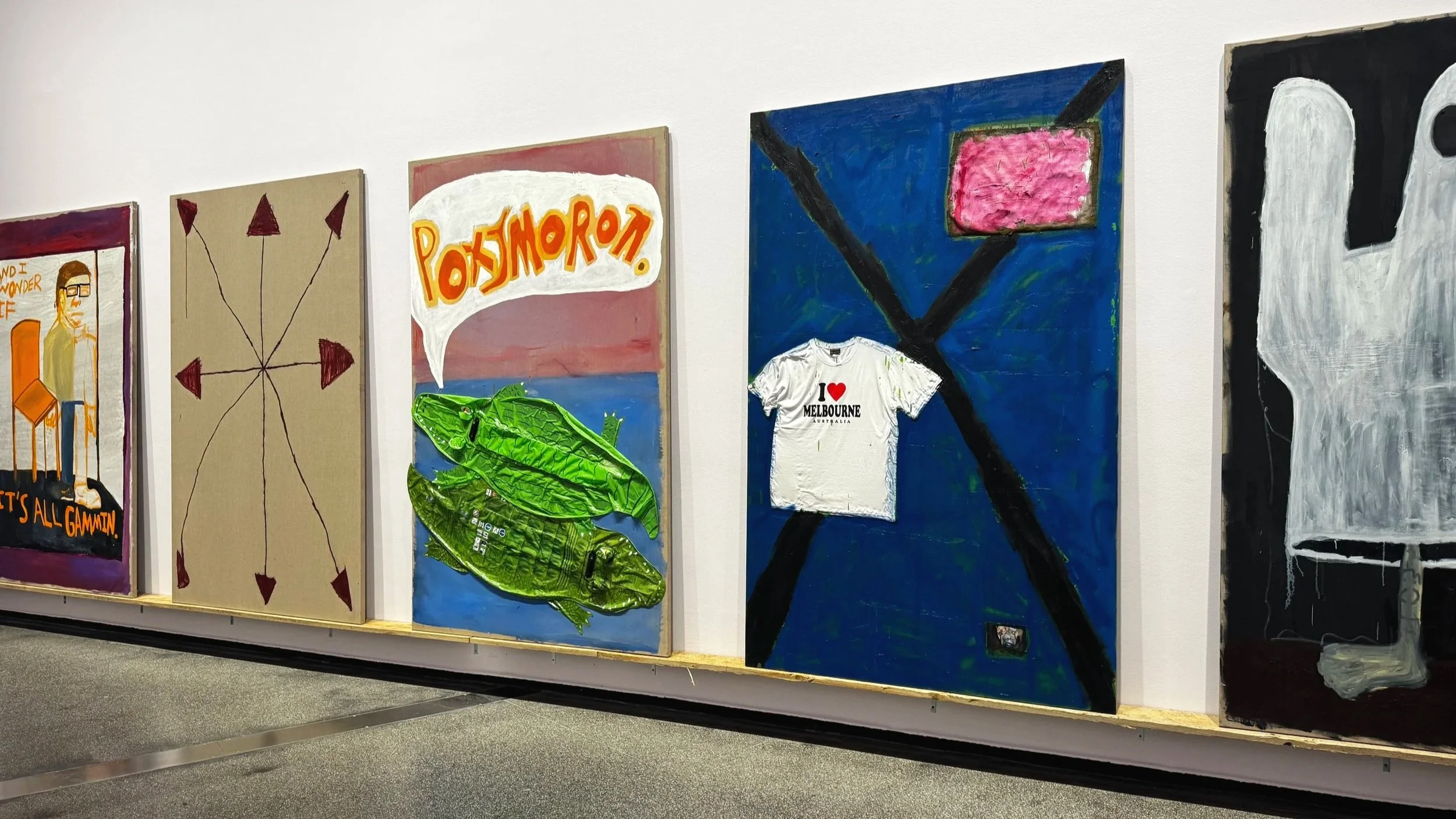
I’ve wanted to write about Nicholas Currie and his work for a while now, but Charlotte says he’s graduated from the cohort of artists that fall into the ‘lowbrow’ category, and has gently encouraged me in other directions every time I’ve suggested it. Admittedly, he is represented by Daine Singer and has now been commissioned for NEW26, so maybe Charlotte’s right. But anyway… Currie is playful and cheeky in his paintings. The massive spiderweb painting nailed into the corner of the room, exactly where cobwebs seem to inevitably collect in every house I’ve ever lived in. The gutted and flattened plastic crocodile pool floaty which we thought was saying ‘postmoron’ but was actually saying ‘poxymoron’ - I couldn’t tell you for love nor money what that means. The paintings (all bigger than me) sat atop an unfinished pine ledge that ran the perimeter of the room. Elevated from the floor slightly, but still leaning against the wall. An air of impermanence permeated the space, as if the artist depicted in his self portrait might walk out from the frame and rearrange the room at any second, like we’re barely one step removed from the studio these were painted in.
Similarly large paintings from Ceasar Florence-Howard interact with, and are informed by, the history of painting. It’s so refreshing to see good abstract paintings, in stark contrast to the poor examples (honestly have seen some dogshit fr) we’ve been subjected to recently. However, they felt undermined being paired with Diego Ramírez who has created a waiting room at the back of the gallery. Florence-Howard’s expressive lively paintings feel like they’re the art on the wall of Ramírez’s waiting room. I can’t imagine this was unintentional, but it feels mildly dismissive of the painter’s stellar work to pair these two together.
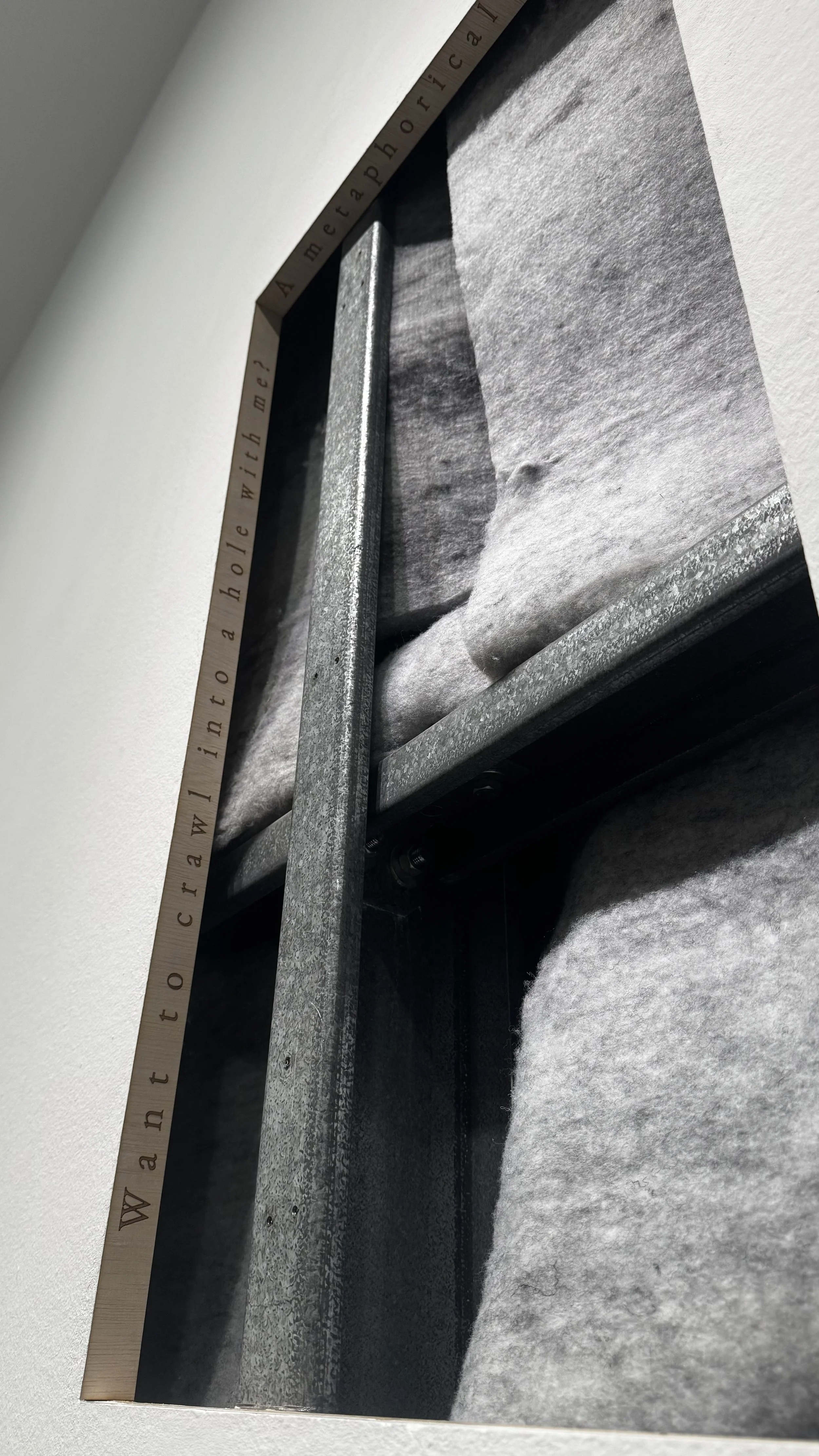
What captures me about Ramírez’s ethereal waiting room is the section of wall that’s been removed. The plaster and plywood hovering mid gallery, the insulation and interior of the gallery walls spilling out and emanating sounds as if there is a world beyond - the one we’re patiently waiting for. It reminds me of something I saw presented in the VCA artspace while I was studying there. I couldn’t tell you who the artist was or even if I’m remembering the work correctly, but from memory; the entire back wall of the gallery was left blank because the artist had hung some 300 drawings and then plastered over them, repainting the wall to look exactly as it had before. It reminds me how art can change the very structure of the space it’s in, altering and rewriting the history of the building itself.
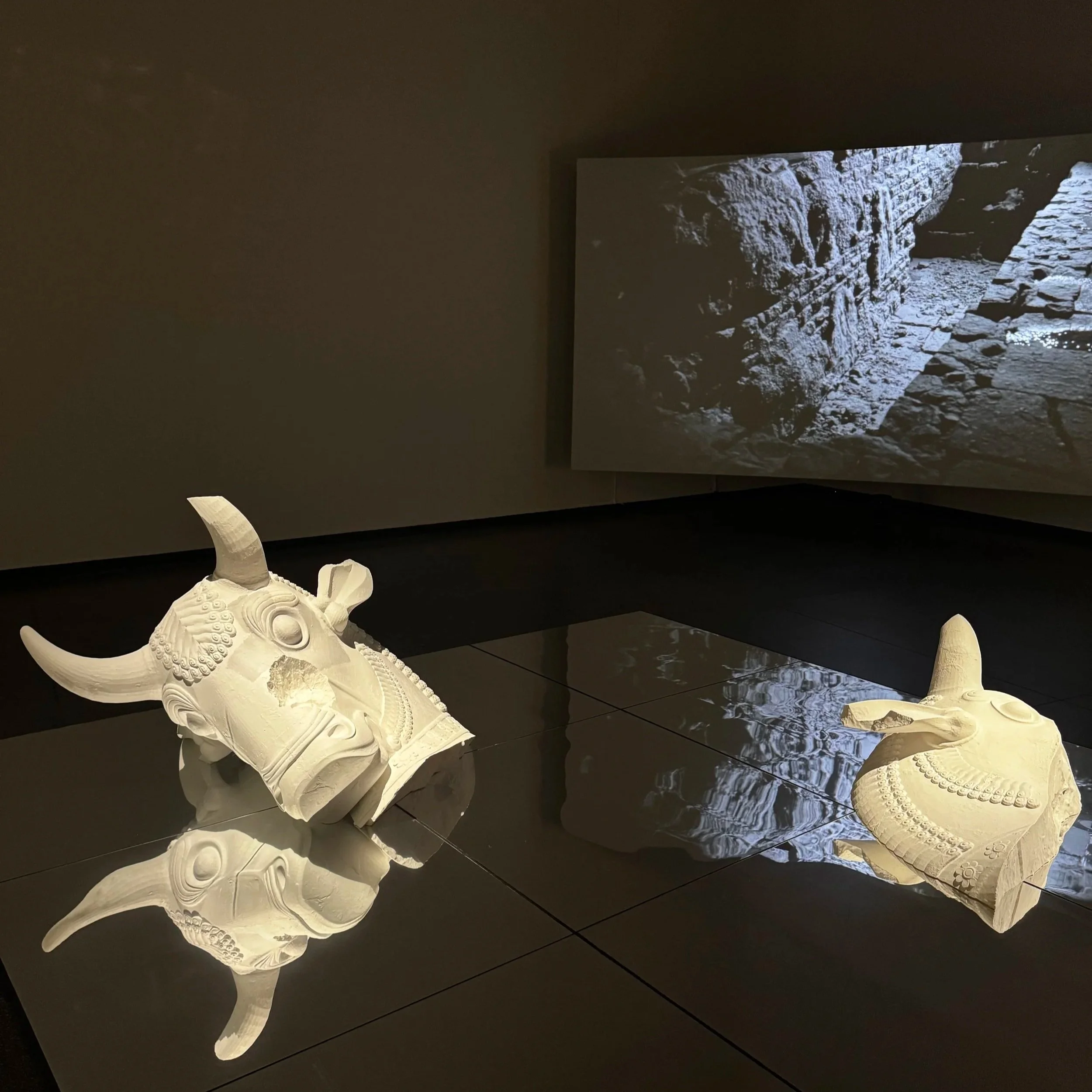
While it’s hard to pick a favourite from the show, Naveed Farro’s work is what truly took my breath away. Monumental cast replicas of a destroyed bull statue sit atop a mirrored base, the film No More Kings playing behind. The artifact when recreated in pristine white plaster becomes detached from the reality of its own destruction, and is remade as a new artifact in itself. Farro’s distance from his Iranian homeland, which he has not yet visited, is played out through the creation of the work. The film that couldn’t be created without a collaborator (Yusefzadeh) on ground in Iran, the cast friezes and objects recreated from scans taken on site by another collaborator (Saadati). The mirrors act like a reflecting pool, light from the spots cast back up into the ceiling, glistening and dancing. It’s so hard to write about how this piece managed to make me feel in such a short time at the opening event. It’s hard to write about work when your only interaction with it is in a fast moving mass of other attendees. I want to revisit ACCA and spend time with Farro’s work in a quieter way. I think my interaction with EJ Son’s giant egg would be different on a second, quieter, visit as well. I haven’t even had the time to write about Amanda Bennett’s industrial tower and listening bench, and Amanda Bell’s captivating video work. The scale of NEW26 and these commissioned works feels monumental, and the scale of the works themselves all equally monumental.
NEW26 is the revival of the series which originally ran from 2003 - 2016 at the gallery, biennially presenting a collection of commissioned work by exciting emerging artists. The evening began with a few speeches, which had a couple notable points. Firstly, the alumni of artists who had presented in the previous iterations of NEW; including Emily Floyd, Destiny Deacon, Louise Weaver, and Darren Sylvester amongst the star studded list. And the second, a comment about ACCA’s position on a trajectory for artists, starting at the VCA and ending at the NGV (lol at the alphabet soup of acronyms). I know it was probably a comment made with no ill intent, a high level statement made to link this show to the universities these artists have recently come through, and then to the NGV where they’ll likely show in future. Yet it stuck out to me because it feels like it glosses over or undermines the work being done outside the three named institutions; which is the space where the galleries and artists we love to focus on and write about live. Lowbrow goes Highbrow will be back, whenever we next have something new to say about an institution.
NEW26 is at ACCA until 22 November.