
RMIT Post-Grad Show 2025
Madelyn McKenzie
We visited the RMIT Post-Grad Show on opening night, because in theory both of our Arts Management Masters projects were a part of this graduate presentation. While our project posters played on loop on a forgotten TV near an elevator bank, there was plenty of work on display from the students graduating from practice based programs. Both Charlotte and I (Bec) reflect on the exhibition below, my words are in purple and Charlotte’s are in red.
Round 2 of the RMIT grad shows left a lot to be desired. For whatever reason, most works felt like I had seen them before, not in the sense that they felt warmly familiar, but that I was being shown the same exhibition time and again. I’ll also admit I had higher expectations for this post-graduate exhibition. I generally liked most of the work, but not much of it jumped out to me as favourites. Lots of it blended into each other. This could be due to grad show fatigue of sorts? Seeing so much graduating student work in such a short amount of time, it’s impossible to not compare it all to each other.
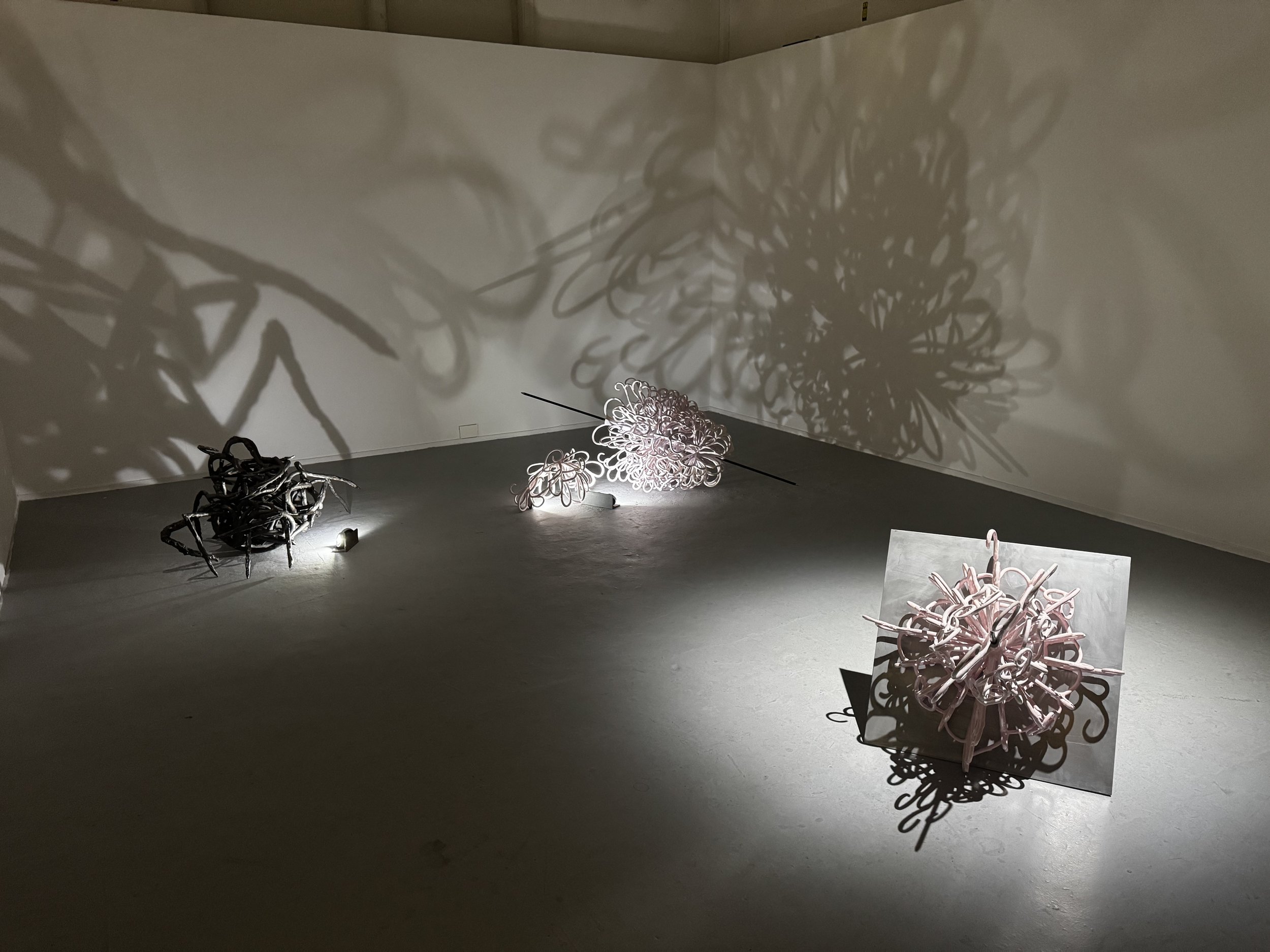
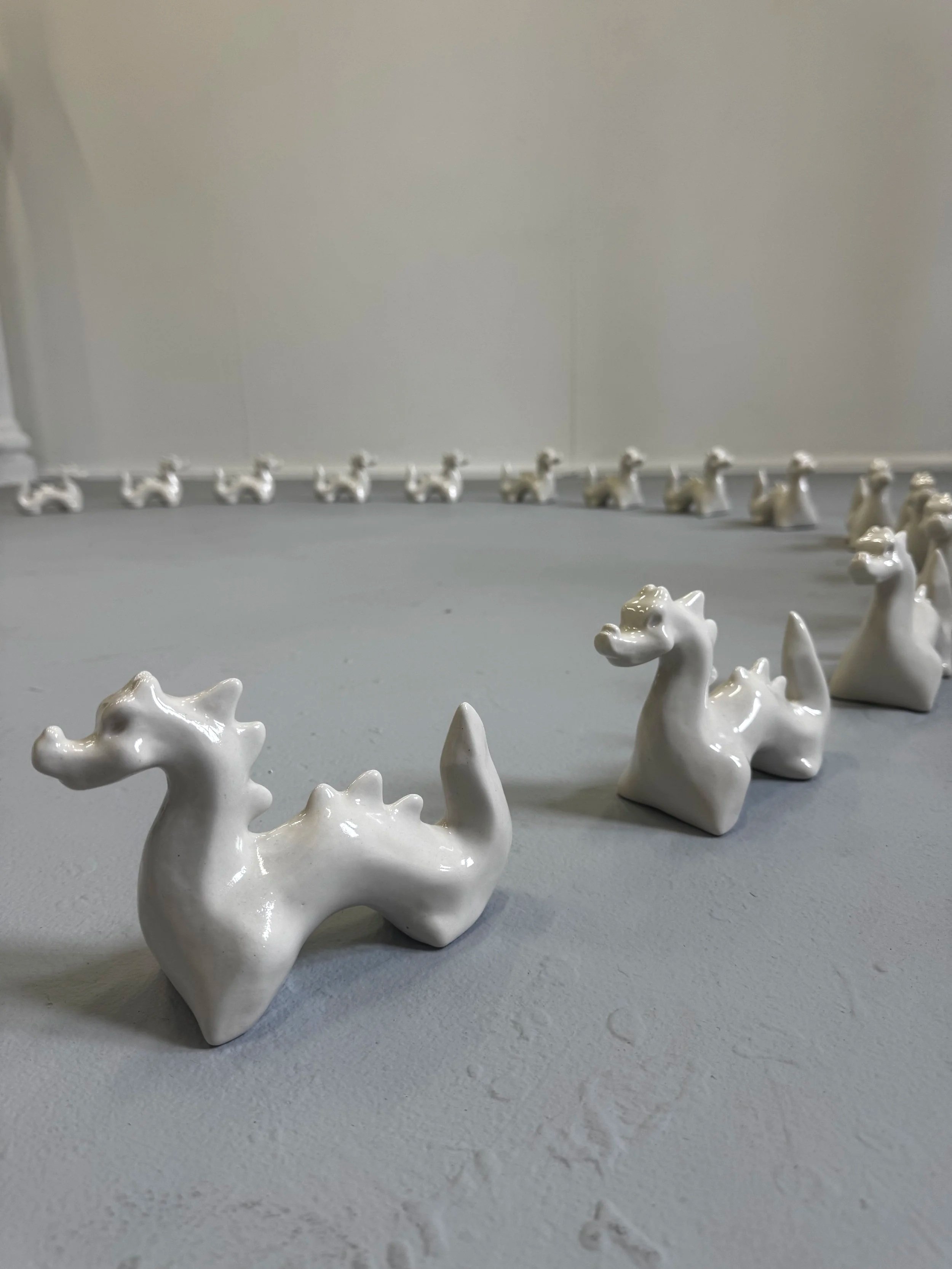
In saying that, I do think it’s mildly hilarious that the work I like most in this post-grad exhibition is installed in the same nook, on the same floor, of the same building, as my favourite work from the recent undergraduate RMIT grad show. Madelyn McKenzie The shields of protection sees abstract floral-esque ceramic pieces illuminated in a dark room. Their loopy chaotic layers cast layered shadows onto the walls behind, which remind me of dappled sunlight filtering down through layers of leaves. These ornate sculptures have a rhythm to them in their flowing folding loops, which then gets lost into a chaos when translated into the shadows that fall from them. I’d be excited to see further iterations of this work, in larger spaces or with more lights, when the constraints of a grad show aren’t boxing it in and limiting it as much. There are ties to be drawn to Yan Xuan’s ceramic dragons, all in the work Where are you? which also play with texture and process, creating forms that are recognizable but totally their own. Walking into the space, I thought that the larger works on plinths were fabric sculptures. Getting up close, I could see them for what they were, and Xuan’s artist statement about working with the initial wool forms had me meditating fully on the transformative nature of the work.
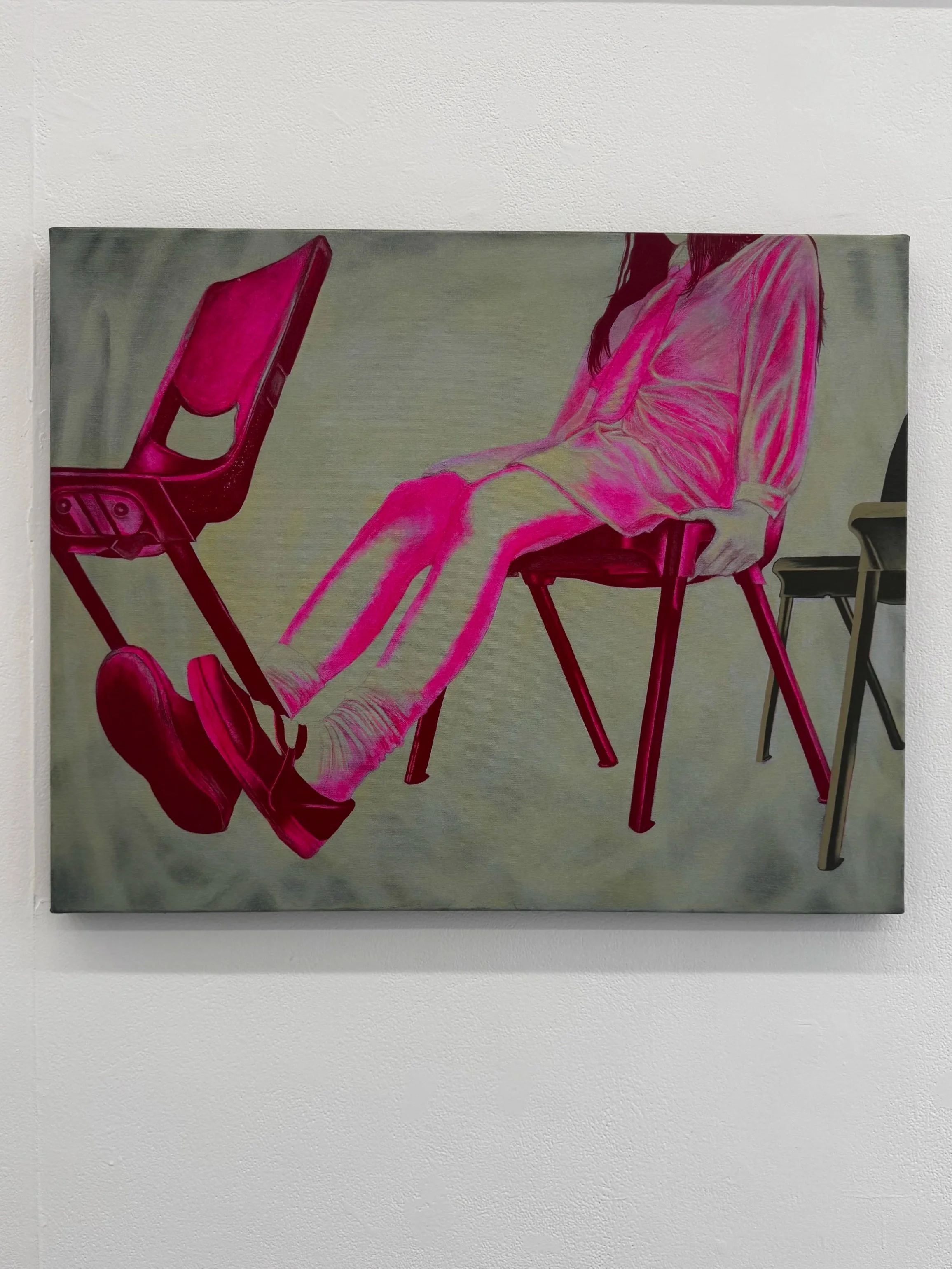
As a Canadian who is deeply missing the cold festive season, Idgie Kagan’s suite of paintings hit me where it hurts. We swap, sometimes called to me from across the room, reminding me of tobogganing down the hills in Ottawa, fully decked out in my hot pink snowsuit, my sister in purple somewhere ahead. The anonymity of the paintings - the figures' faces obscured or entirely absent- furthers the intimacy of the scenes. Hallway also feels like a snapshot of my own, the bodies in the scene becoming my friends, my cousins. We swap, sometimes is a gem of a work, truly unlike any other in the show. I really liked Christina Rankin’s paintings and fabric works. These feel like a fever dream of somewhat similar school girl nostalgia. Misremembered moments layered over one another to form a patchwork quilt of neon memories that might be not quite real.
I’m not sure if the contrast is intentional or not but Tyler Tippett’s larger than life Second Skin photographs about queer kink community are placed against Mingyu Kang’s Ahn-nyoung, Ms. Myoung-ja about the artist’s presumably deceased grandma. As you round the corner there’s a photograph of a person wearing a full faced latex mask with a strap on dildo that hands down to their bare knee, and in the same sight there’s a photograph of a telstra phone box with Kang’s grandma’s photo inside. It feels like it detracts from both artists' work by putting them next to each other, but its also kind of funny?
Ella Simpson’s series of works, confronting the artist’s OCD and fear of disease were all encompassing. Zip-tied to PVC frames, the works forced you to look at them and surround yourself with the larger than life human medical specimens. The works, in their vibrant, bold colouring were almost abstracted from their source material - it took me minutes to figure out what I was truly staring at, by then I was too engrossed to be grossed out.

While I’m touting this as the RMIT post-grad show, yet that’s not entirely true as the Bachelor of Photography students have been included in this celebration, instead of the iteration two weeks ago. Doris Wei is one such photography student. BETWEEN SELVES is a table top installation which alternates high contrast black and white images with their inverted twin, and places mirrors between each pair. This is such a hard work to describe in words, as the mirror is cleverly placed to layer and split and refract the images as you move around the work. One definitely to be seen in person. My Mother’s Clothes, the photographic installation from Selina Vicenzino fully encompasses everything it sets out to. The work is an achievement, as much of an installation as it is a love letter to the women in the artist’s life. She contends with femininity and power, sisterhood and gender roles with a deft hand. Between the artist statement and the work itself, the clarity Vincenzo has about her practice and the layers of this work were subtle brilliance.
Near the end of my travels through the grad show I found Yining Lu’s SIsyphean Circle. Legs akimbo, the circle is grounded by a vulva-esque set of scales. The fish on each side are pulling, trying to weigh their own side while ultimately all part of the same circle. Lu’s room of paper works is fascinating. The main work is flanked by two smaller works, as paper. A fish eating a pomegranate and a human eating a fish (holding a pomegranate) bear witness to the unending, sisyphean struggle. It’s bright and playful and weird - a wry commentary on gender roles and the illusion of choice, grounded by colour and evoking a long history of shadow puppetry.
This is the fourth grad show we have covered this year, and we’ve only scratched the surface of the art school offerings in the city this time of year (sorry to Deakin and LaTrobe). Some shows are information overload, with the sheer number of graduates overwhelming the space, leaving the works fighting to be noticed. Others, where there is the luxury of space really highlight whether an artist has found their voice during their tenure - for better or worse, there’s nowhere to hide.
The exhibition continues until Sunday December 7th on campus.